



DENSO Air Conditioning System Advice – Bad Smells

To continue to work as it should however, the air conditioning (AC) system must be properly used and correctly maintained.
Original equipment pedigree
As an AC specialist and a trusted original equipment supply partner for many vehicle manufacturers, DENSO is qualified to provide expert advice to help motorists get the best from their heating and ventilation systems, and for professional technicians to recognise and rectify faults effectively.
What’s that smell?
One of the most common complaints from vehicle owners is the unpleasant smell that can sometimes come from the system and how can it be remedied, as well as prevented from reoccurring.
While the nature of these smells can vary, their causes are generally associated with how the AC system is used and how frequently it is maintained.
The smells generally come from mould and bacteria that forms and grows on the parts of the AC system that become, and crucially remain, damp or wet from condensation that settles on its internal surfaces.
This condensation develops because the moisture that is naturally present in the atmosphere is drawn out of the air and settles on surfaces that are cooler than its ambient temperature. As a result, in addition to the musty smells that come from bacteria or mould, should the air also contain particles such as sweat, pet smells, smoke or perfume, these odours can also settle on the surfaces and cause other unpleasant aromas.
Other odours can be due to wear of the aluminium coating on the AC evaporator, for example, which although detected as metallic, rather than organic, can still smell unpleasant.
What can be done?
So, is there anything that owners can do to prevent the occurrence of these smells and what can technicians do to help?
When it comes to owners, the answer is yes, and that is to use the AC system regularly, in accordance with the instructions in their vehicle’s operating instructions.
Using the system regularly, not just when the weather is hot, is the best way to disperse the condensation on the internal surfaces, which helps prevent the mould from getting established. In addition, to help prevent condensation from forming, it’s advisable to switch off the AC shortly before reaching the destination, but leave the blower on, before the engine is stopped.
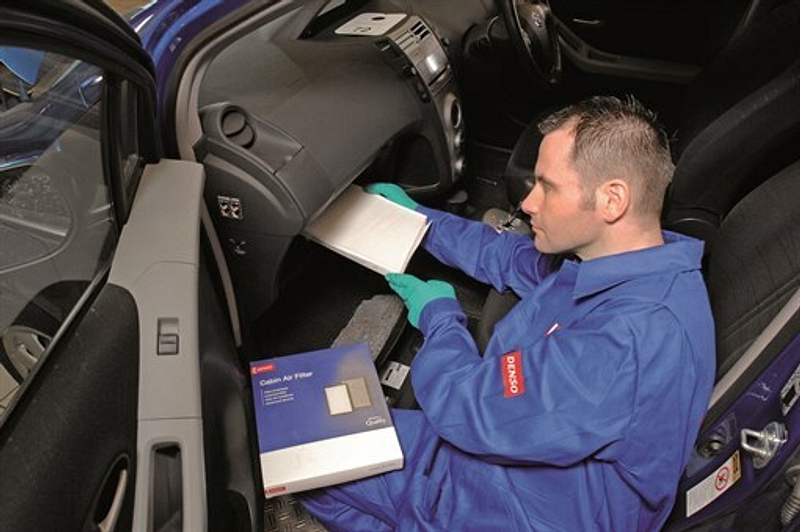
Workshop responsibilities
When it comes to the role of technicians, as well as restating the previous message to their customers, carrying out regular AC service and maintenance is the primary goal. However, checking the condition of the cabin air filter (CAF) is also vital.
A dirty CAF reduces the efficiency of the entire AC system, as it has to work much harder to draw the air from outside the vehicle and circulate it through the cabin. Upgrading the quality of the CAF to a version that incorporates a carbon activated layer, or with DENSO’s soon to be launched ClearAir+ CAFs will further improve air quality. These CAFs have all the properties of carbon versions, plus antibacterial and antiviral functions. This improves the purity of the air, which in itself will reduce the likelihood of unpleasant and harmful odours outside the vehicle from getting inside.
Should the build up of mould be particularly great, the only option is for technicians to clean the AC evaporator, which is the component generally most prone to condensation, and clean it through either an ultrasonic or ozone cleaning process. However, do not use chemicals which contain chloride (CI) or have an high PH value to clean the evaporator. These chemicals can damage the special coating and cause corrosion of the evaporator surface (white rust). Nonetheless, to prevent the problem reoccurring will require the owner to use the system regularly and follow the handbook’s instructions, as previously mentioned.
For more information and best practice AC system advice, visit the AC section of the DENSO website.
Further details of the DENSO Aftermarket programme are available online at: www.denso-am.eu