



“Get to grip with air conditioning systems,” urges DENSO
Some background
The reasons why AC maintenance has not previously featured in these schedules largely revolved around the perceived costs, particularly the projected total cost of ownership over the life of the many vehicles owned by leasing companies. However, the end result is that despite being an important system within a vehicle, AC remains one of the least understood subjects in the independent workshop.
To make matters worse, as there is no mention of AC service in their owners handbook, motorists also don’t think of it as a service item, and ironically, the one AC offering that most workshops do provide, namely ‘topping up the gas’, is arguably the least appropriate solution. This is because it is usually a symptom of an underlying problem, which is the issue that should be dealt with, but is almost always overlooked.
The outlook
Having addressed the rather gloomy background, there is a more positive outlook, one that is brought into even greater focus with the growth in the number of BEVs and modern hybrids now in the vehicle parc, which are gradually beginning to find their way into independent workshops.
These vehicles generally do include the AC system in their prescribed service schedules, as it not only provides important cabin comfort for the occupants, but is also a crucial factor in the thermal management of the vehicle, particularly the high voltage battery, which is vital to ensuring the range, efficiency and reliability of the whole vehicle. With this change in its priority comes the opportunity to specialise in AC service, argues DENSO.
What does AC service include?
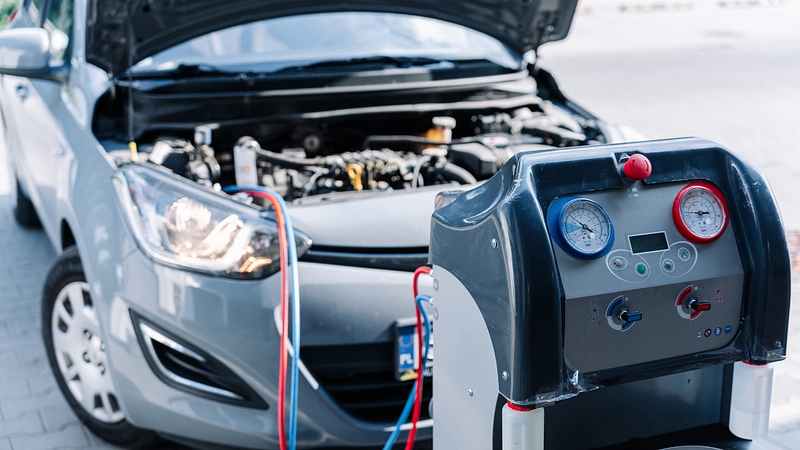
In a nutshell, the process comprises the recovery of the refrigerant, visual inspection of the system, leak finding, evacuation, charging and performance testing.
Naturally, in common with almost all service and repair work, specialist equipment is necessary to undertake AC service and unfortunately, even here difficulties can arise.
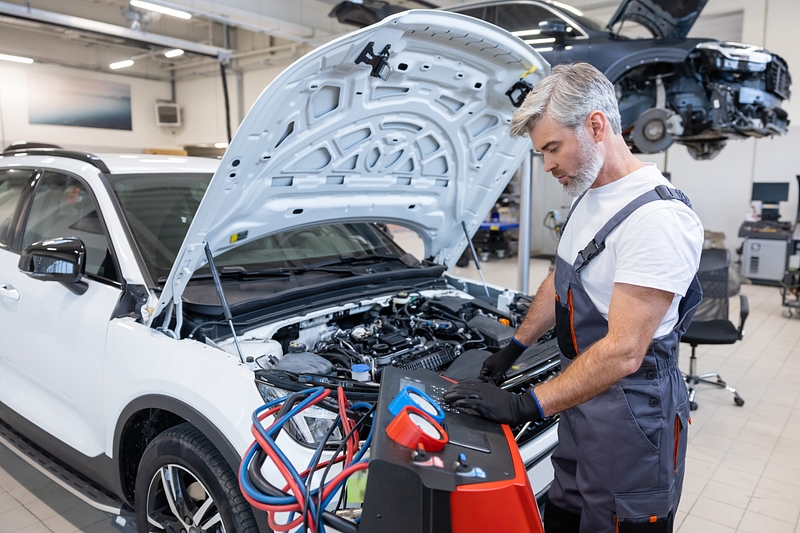
Understandably, many workshops will opt for an automatic machine as, theoretically, it can do the job more efficiently, allowing the technician to carry out other tasks, like draining the engine oil or checking the brakes, during the procedure. However, while they are good at running a predetermined cycle, they provide limited process control, and can potentially mask an underlying problem, as the technician is often unaware of what it is actually doing, and so has no idea if something is wrong.
To help potential leak detection, for example, many machines will automatically introduce UV-dye into the system, which is helpful to find the source of a leak before rectifying the problem and re-gassing, but this process must only be done once. This is because, in effect, it dilutes the oil/refrigerant mix, and a mixture that is too dilute can lead to compressor failure due to lack of lubrication. So, without knowing if the system already has UV-dye, the technician doesn’t know whether to override this function of not.
Each of the service steps highlighted previously are crucial in ensuring the overall health of the AC system, and each must be undertaken proficiently to guarantee the right outcome. Examples include only using the low pressure side of the loop to recover refrigerant, to check for damage or corrosion throughout the system, to use the most appropriate method for leak testing, to use both the low and high pressure connections to evacuate the system, to understand which ports to use when charging the system, and then to carry out a thorough performance test of the system after the service is completed.
The opportunities
Although the examples highlighted emphasise the complexities of the AC system, it is also a fact that in contrast to some vehicle technologies that are coming to the end of their development, and some cases even their lifecycle, the AC system will be ever present, irrespective of the powertrain and vehicle design.
Therefore overlooking the ongoing profit opportunities associated with an AC specialism, would seem somewhat foolhardy.
Necessary training
As is apparent, AC service and repair cannot be undertaken lightly, rather it requires specific training to equip technicians with the knowledge and skills they need to tackle these important vehicle systems with confidence and to ensure they can complete the work thoroughly and successfully.
As an original equipment manufacturer and AC system supplier to vehicle manufacturers globally, DENSO is ideally placed to provide the required training, as well as having the ability to supply the premium quality replacement parts needed to complete the process.
DENSO’s training programmes can be conducted face to face, initiated via the company’s trusted distributors in all markets throughout Europe, but they are also supplemented by its comprehensive online resources through the denso-technic.com e-Learning portal.
These online tutorials address subjects such as the Basics of AC, Oil Contamination, Common Compressor Failures, as well as the Seven Basic Steps of AC Service, which brings us neatly back to the beginning and the necessity to upskill the workforce, to enable independent workshops to address the existing and ongoing demand for AC service and repair.